
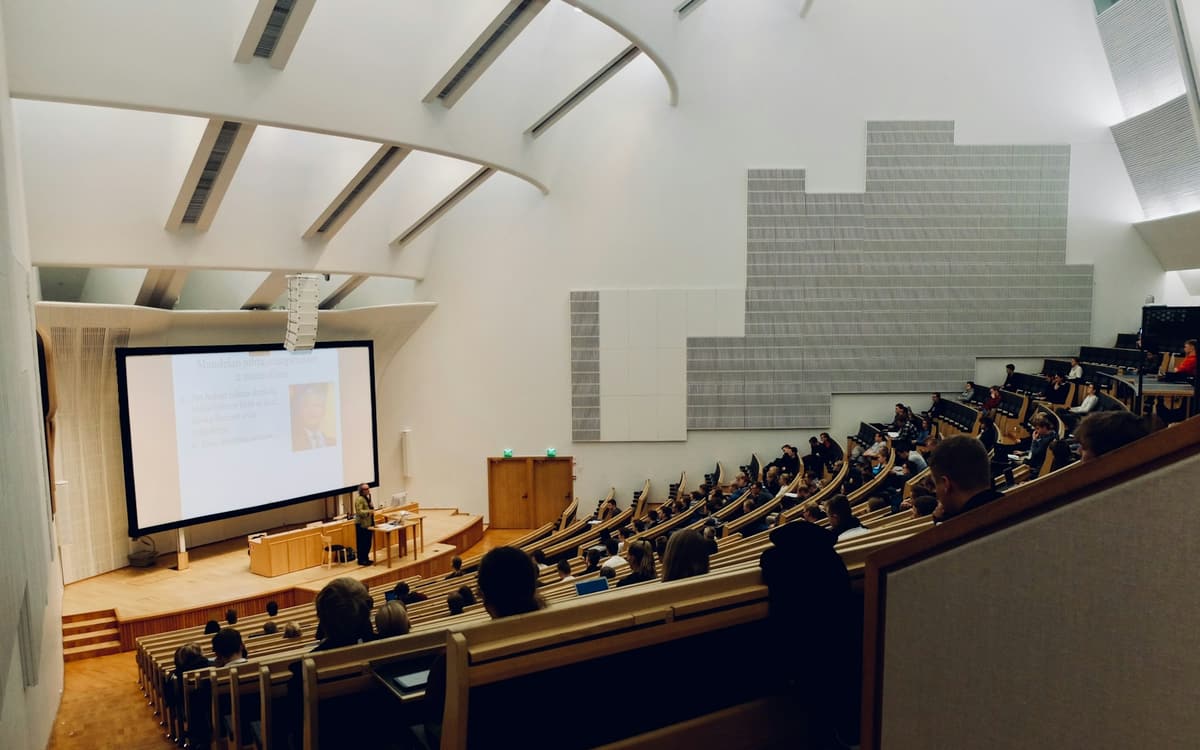
The number-one mistake in a Master’s oral defence is rushing through a chapter-by-chapter summary of the written manuscript. Keep one simple fact in mind: the committee has already read your thesis or internship report. During your fifteen or twenty minutes at the lectern, examiners are not looking for an audio version of your table of contents; they want to hear perspective, clear reasoning behind your methodological choices, intellectual honesty about limitations, and composure in scholarly or professional debate.
This practical guide covers the exact structure of the defence, word-for-word phrasing you can adapt from opening greeting to final sentence, slide design rules, vocal delivery, body language, dress code and calm strategies for tough committee questions.
1. How a Master’s defence actually unfolds
Most Master’s defences last forty-five to sixty minutes and follow four predictable stages:
- Setup and opening (2 to 3 minutes): you check your slides on the projector before the chair calls the session to order and states your speaking time.
- Your uninterrupted presentation (typically 10, 15 or 20 minutes depending on programme rules): confirm the exact time limit beforehand. Running four minutes over risks being cut off before your main point.
- Questions and discussion with the committee (20 to 35 minutes): each examiner shares feedback and probes your methodology, interpretations or recommendations. Final honours are frequently decided here.
- Closed deliberation and feedback (5 minutes): you step outside briefly while the committee agrees on the grade, then return for oral remarks.
2. Minute-by-minute outline (15-minute model)
Scale each block down by a third for a 10-minute slot, or expand findings and discussion if given 20 minutes:
- Greeting, introduction and hook (1 min 30): thank the committee, state your name and track briefly, and explain the real-world observation or puzzle that sparked the study.
- Research question and core angle (2 min): state your central question, objectives and analytical thread clearly.
- Methodology or field placement setup (3 min): justify how you gathered evidence, including practical trade-offs made in the field.
- Three headline findings or achievements (5 min): spotlight your three strongest insights backed by concrete evidence or figures rather than trying to mention everything.
- Critical distance, limitations and implications (2 min 30): state honestly what you would refine with hindsight and present actionable takeaways or avenues for further research.
- Crisp conclusion and handover (1 min): answer your initial question in two sentences and invite discussion.
3. What to say: adaptable phrases from opening to close
Never memorise a full script word for word — if you lose one line, panic sets in. Instead, memorise your anchor sentences (opening, transitions and closing) so your transitions stay effortless.
Greeting the committee and introducing yourself (first 30 seconds)
Wait for the chair’s nod, take one steady breath, make eye contact across the table and begin calmly:
Move straight into a concrete hook: a striking empirical figure, a field paradox, or the operational bottleneck that prompted your investigation.
Guiding listeners with clean transitions
Because listeners cannot flip pages during a talk, signpost every shift with one short sentence:
Closing with authority (never end with “So yeah, that’s it”)
Avoid trailing off at the end. Your final sentence should answer your central question and hand the floor back cleanly:
4. Tailoring your angle: research thesis vs internship report
- Defending a Master’s thesis: foreground your problem framing, methodological rigour, how your findings converse with key authors, and any fresh reflections developed since submitting the PDF.
- Defending a Master’s internship report: never spend five minutes reciting company history (especially when your company mentor is sitting on the panel). Focus on the business problem tackled, trade-offs navigated, updated results achieved after submission, and the practical realism of your recommendations.
5. Designing clean slides that support — rather than compete with — your voice
Slides exist to clarify structure and show visual proof, not to act as your teleprompter:
- Aim for 10 to 14 slides for a 15-minute presentation (excluding title slide and backup slides).
- Stick to one core message per slide, using assertion titles (“Validation turnaround dropped by 28%” beats “Results — Part 2”).
- Cap text at five short lines per slide at 24 pt minimum, with strong contrast and clean typography — see choosing fonts and building a colour palette.
- Favour clean diagrams, process flows, summary tables or one highlighted interview quote over dense bullet walls.
- Place 2 or 3 hidden backup slides after your thank-you slide (sample breakdown, regression table, recommendation budget): pulling up the exact chart when asked a detailed question shows thorough preparation.
6. How to speak: pace, projection, pauses and notes
- Deliberately slow down for the first 90 seconds: adrenaline speeds speech up. Starting slightly slower than feels natural steadies your breathing and signals confidence.
- Project toward the back row with an open chest, keeping your chin up rather than speaking into your notes or turning toward the projection wall.
- Replace filler words (“um”, “uh”) with silent two-second pauses: pausing after a key statistic lets the committee absorb the point and take notes.
- Use numbered index cards rather than full A4 sheets: full paper sheets shake visibly when hands are nervous and tempt you to read aloud. Write bold keywords and time checkpoints (`[04:00]`, `[09:30]`, `[13:00]`) only.
7. How to present yourself: posture, eye contact, hands and attire
Non-verbal presence sets the tone before you finish your first slide:
- Posture: if standing, plant both feet shoulder-width apart instead of swaying. If seated, sit upright on the front half of the chair with forearms resting lightly on the table.
- Eye contact: sweep calmly across every member of the panel, not only your supervisor or the friendliest face in the room. Hold each person’s gaze for three seconds at a time.
- Hands: keep hands open and visible above waist or table height; avoid crossed arms, hands in pockets or clicking a pen (set the pen down while presenting, pick it up for Q&A).
- Dress code: wear neat, understated professional clothes suited to your discipline that feel comfortable to breathe and move in. Test the outfit days earlier so tight collars or stiff new shoes never distract you.
8. Managing nerves before and during the defence
A fast heartbeat before walking in is normal adrenaline sharpening focus. Three habits keep it productive:
- Outside the room: run three slow breathing cycles (inhale 4 seconds through the nose, exhale 6 seconds through the mouth) to lower heart rate physiologically.
- Know your opening three sentences cold: surviving the first sixty seconds smoothly cuts anxiety in half.
- Keep a glass or bottle of water within reach: taking one sip before Q&A clears a dry throat and buys three calm seconds.
9. Answering tough committee questions with poise
Challenging questions are not traps; examiners want to see how you reason on your feet.
- Listen all the way to the end without interrupting, jotting down two keywords on a notepad.
- Briefly reframe multi-part questions (“If I follow your point accurately, you are asking both about sample selection bias and whether the recommendation scales to smaller firms…”).
- Never get defensive: acknowledge genuine limitations plainly, explain the real-world constraint behind your choice, and state how a follow-up study could address it.
- If you do not know a specific figure or author, never bluff:
10. Seven-day countdown to defence day
11. Mistakes to avoid at all costs
- Running over your allotted time or sprinting breathlessly through your conclusion.
- Reading slides word for word with your back turned to the committee.
- Opening with self-undermining apologies (“Sorry, I ran out of time on chapter three…”).
- Arguing combatively with an examiner or blaming your supervisor or host company.
- Bringing a single presentation file with no PDF backup.
Oral defence checklist
Still earlier in your Master’s journey? Follow our companion guides on framing your research proposal, writing your Master’s thesis and structuring your internship report. Need executive-ready slide design for a high-stakes presentation? Let’s talk.